🧠 By 2025, AI-driven X-ray inspection will systematically replace purely manual “eyeballing” BGA inspection in mainstream SMT/PCBA factories. This shift stems from its quantifiable advantages in defect detection rates, consistency, and traceability—no longer merely serving as an image-based auxiliary tool.
1 Why AI-Driven X-Ray Technology Leads the Way
Scanditron X-ray machine with “PRE-WARN X-RAY ON” radiation warning label
Higher defect detection rate and consistency (replacing the original vague claim of “60–90% vs ≥97%”)
-
Literature reports indicate that an automated X-ray hybrid algorithm for BGA solder balls achieved over 97% defect detection accuracy in practical testing, remaining effective even for obscured solder balls. This significantly surpasses the typical consistency levels of manual image analysis. techscience+1
-
Market research indicates that Automated X-Ray Inspection (AXI) systems, leveraging algorithms and machine learning to reduce manual dependency, are deployed for high-precision inspection of complex PCBs. Their core advantages lie in high accuracy and repeatability, whereas manual operations are prone to variability due to fatigue and experience differences.
Real-world trends, not “fictional factory” cases
- Multiple equipment and process guidelines indicate that 3D X-ray and AI-assisted defect identification have transitioned from laboratories to production lines. These technologies detect defects such as voids, misalignment, and bridging in BGA solder joints, automatically logging results into quality systems. Such applications are already prevalent in automotive electronics and high-reliability products.
2 How AI-X-Ray Quantifies Key Quality Metrics
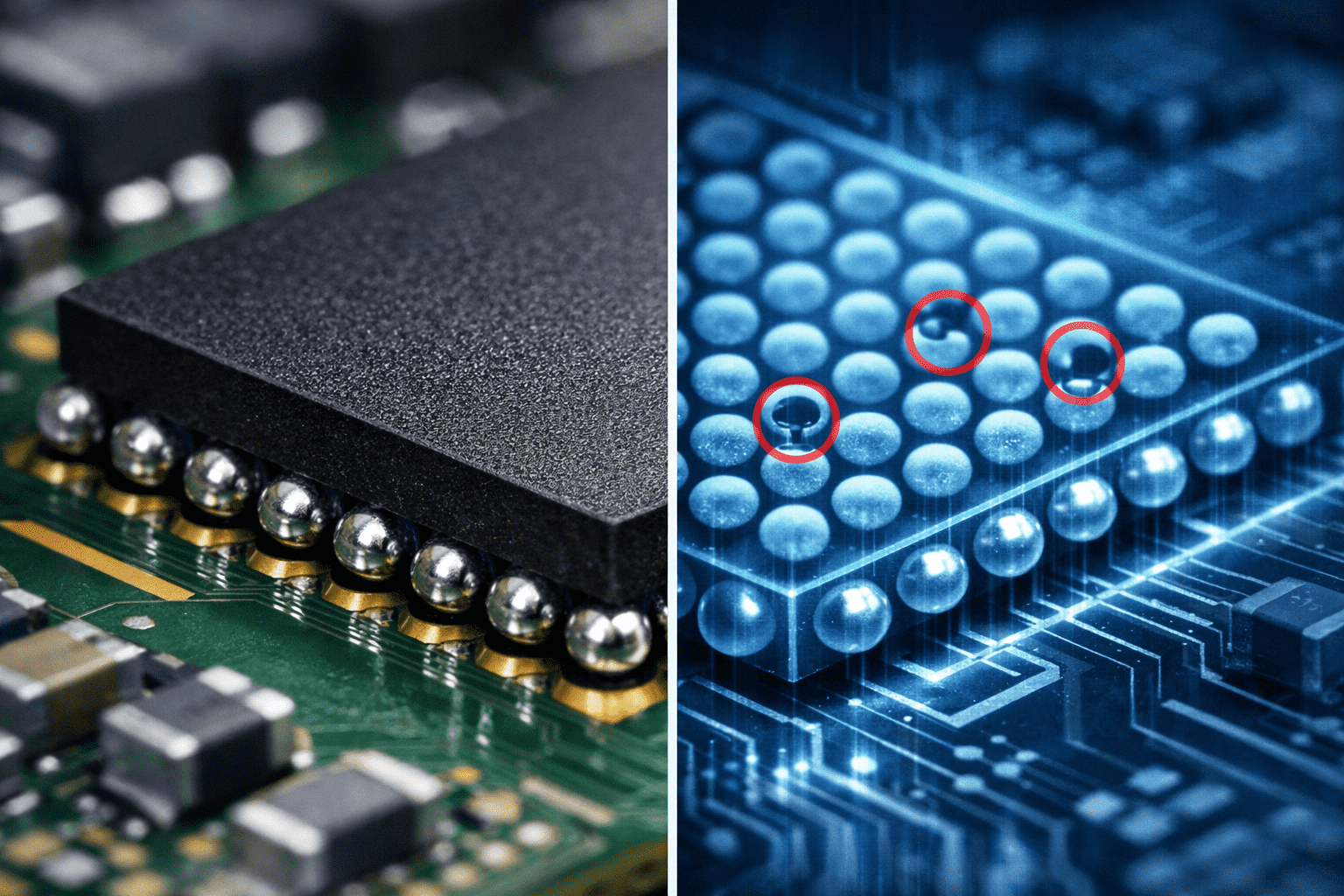
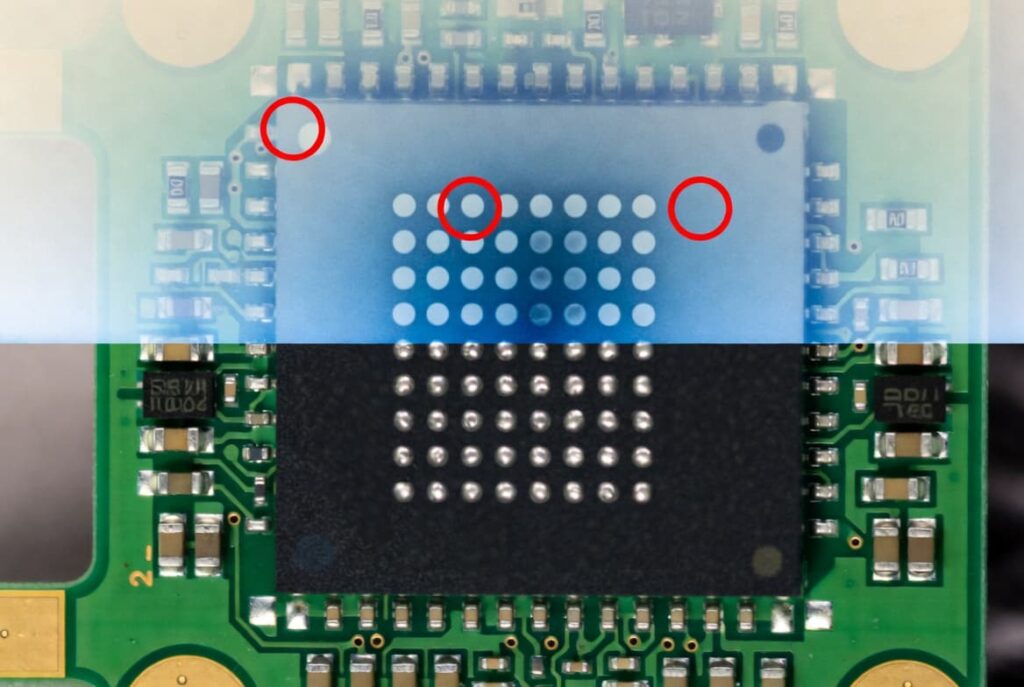
3D X-ray image of BGA solder joints showing spherical solder balls in grid array
Quantitative Analysis of Voids: Speaking with Real IPC Thresholds
-
Industry data and IPC interpretations indicate: For BGA solder joints, standards like IPC-A-610 / IPC-7095 typically recommend that the total void area of a single solder ball should not exceed approximately 25% of the joint's cross-sectional area. Class 2 and Class 3 generally use 25% as the upper limit, while some high-reliability applications further tighten internal specifications beyond this baseline.
-
AI-enhanced 2D/3D X-ray systems enable pixel-level segmentation of solder joint cross-sections, automatically calculating void ratios and determining pass/fail based on thresholds—eliminating reliance on operators' subjective “it looks okay” judgments. This marks a critical shift from ‘eyeballing’ to “quantification.”
Hidden Defect Detection: The Reality of 3D/CT Capabilities
-
3D X-ray or oblique computed tomography (CT) is already employed for internal cross-section analysis of BGA solder joints. It can identify structural defects like voids, incomplete wetting, bridging, and Head-In-Pillow (HIP) through multi-angle projection reconstruction.
-
In contrast, AOI or visual inspection can only examine component appearance and peripheral solder joints, lacking the ability to penetrate the BGA's underlying structure. This is why high-reliability products universally regard X-Ray as an essential BGA inspection method rather than an “option.”
3 Actual Results: Tangible Improvements in Efficiency and Cost
Production Line Cycle Time: From Manual Interpretation to Automated Statistics
-
Automated X-Ray systems are specifically engineered for high-volume production environments. Their features include high-speed scanning and minimal human intervention, enabling full board inspection in significantly less time than manual methods while maintaining high accuracy. This capability is considered a major advantage in the highly complex PCB industry.
-
Documentation and equipment specifications emphasize that AXI systems automatically identify defects and output results through algorithms. Manual review is required only for a small number of challenging images, significantly reducing the time cost of “manually scrutinizing each board for tens of seconds.”
Market Size Validates Investment Direction
-
Market reports indicate the global PCB X-ray inspection system market reached approximately $800 million in 2023 and is projected to grow to around $1.5 billion by 2032, with a compound annual growth rate (CAGR) of about 6.8%. A key growth driver is the demand for automated inspection of high-quality, high-density PCBs.
-
Another forecast for the overall X-ray inspection system market indicates a size of approximately $760 million in 2023, projected to grow to $1.22 billion by 2032. 3D X-ray and AI-driven automated inspection are identified as the fastest-growing technological directions.
4 Typical Application Scenarios of AI-X-Ray in BGA Inspection
-
Automated inspection algorithms for BGA solder balls have been demonstrated in published research: Through 2D preprocessing + 3D CT reconstruction, the algorithm can segment and identify defects in obscured solder balls. Field testing shows defect detection accuracy exceeding 97%, indicating engineering-ready performance on real packaging samples.
-
In actual EMS factories, such algorithms are typically integrated into AXI equipment to perform online detection of BGA solder joint voids, bridging, and missing balls. Results are recorded in the MES system alongside board IDs, timestamps, and reflow profile data for traceability and process optimization—not merely as “laboratory analysis tools.”
-
Factory-side experience consistently indicates: After implementing 3D X-Ray + automated analysis in high-reliability production lines, field failure rates related to hidden BGA solder joints show significant reduction. This manifests as decreased rework/scrap rates and fewer customer returns—not merely as a marketing slogan claiming “a single metric reached 99.5%.”
5 Three Common Misconceptions
❌ Misconception 1: Manual Visual Inspection Is Sufficient
-
Manual visual inspection is widely recognized for issues like “fatigue, high subjectivity, and poor repeatability.” Error and miss rates significantly increase during prolonged, continuous evaluation of similar images—a phenomenon frequently documented in defect detection and quality inspection research.
-
For hidden solder joints like BGAs, human inspectors can only assess limited 2D X-ray angles and remain susceptible to contrast variations and artifacts. Automated algorithms, however, apply consistent thresholding, geometric, and statistical analyses to identical images, mechanically reducing human oversight.
❌ Misconception 2: X-Ray is Only for Large Enterprises
-
The PCB X-Ray inspection system market is projected to grow from approximately $800 million in 2023 to $1.5 billion by 2032, with a CAGR of about 6.8%. This indicates increasing adoption of automated X-Ray as a quality control tool across enterprises of all sizes—no longer the exclusive domain of major manufacturers.
-
With the commercialization of 3D X-ray and AI algorithm modules, equipment manufacturers are also launching compact or offline X-ray inspection solutions for small and medium-sized SMT factories. These are designed for 100% inspection or sampling of critical BGA areas, a trend explicitly highlighted in industry analysis.
❌ Misconception 3: AOI and X-Ray Serve the Same Purpose
-
AOI primarily relies on visible light imaging, making it suitable for detecting surface defects such as missing components, misalignment, polarity errors, and solder bridges on exposed pads. However, it cannot penetrate to observe internal structural issues within BGA solder balls or multilayer boards.
-
X-Ray is explicitly described as “essential for detecting hidden defects inside BGAs or multilayer boards.” It uniquely provides structural insights for identifying BGA void solder joints, internal cracks, solder joint defects, and Head-In-Pillow failures. Many factories employ a combined AOI + X-Ray approach to achieve comprehensive coverage of both surface and internal defects.
Interlink Opportunity: "Unlike standard components where Visual Inspection (link to main article) is straightforward, underfilled parts require..."