Avoiding the "Popcorn Effect": Why Your BGA Chips Crack During Rework
In the precision world of BGA (Ball Grid Array) repair, few things are as disheartening as hearing a distinct "pop" during a reflow cycle. You’ve spent hours diagnosing the board, only to find the chip physically bulged or cracked. This phenomenon, known as the "Popcorn Effect," is the silent killer of high-end GPU and CPU repairs.
The Data: Why Moisture is Your Biggest Enemy
To understand the scale of this challenge, consider these industry benchmarks:
- Moisture Criticality: If a PCB’s moisture content exceeds 0.1% by weight, the probability of a "popcorn" failure during lead-free reflow (which requires higher temperatures) increases by over 70%.
- Temperature Pressure: At 220°C (standard reflow temp), trapped water molecules expand to over 20 times their liquid volume, creating internal pressure that exceeds the structural integrity of the plastic IC packaging.
- Success Rate Gap: Professional labs that implement a mandatory 125°C / 24-hour pre-baking cycle report a 95% higher success rate on aged components compared to those who skip this step.
The Problem: Fatal Structural Damage
The "Popcorn Effect" manifests as internal delamination, bond-wire breakage, or visible external cracking of the chip. Once this happens, the component is permanently destroyed. For high-value boards like gaming consoles or industrial controllers, this means a total loss of the repair investment.
The Root Cause: Hygroscopic Absorption
Electronic components are hygroscopic—they naturally absorb moisture from the air. When you apply rapid, localized heat to a "wet" chip, the moisture turns into high-pressure steam instantly. If the steam cannot escape through the packaging fast enough, it forces its way out, causing the chip to "pop" like a kernel of corn.
The Solution: Scientific Multi-Zone Preheating
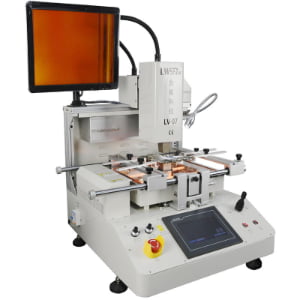
The key to preventing this is not just "less heat," but controlled, uniform thermal management. To safely evacuate moisture and manage thermal stress, you need a system that balances top-down reflow with massive bottom-up preheating.Professional-grade systems, such as the LV-05 BGA Rework Station, utilize a three-temperature zone architecture to ensure success.
Industry Standard Exemplified: The LV-05 Technology The LV-05 BGA Rework Station provides a masterclass in moisture management through its independent three-temperature zone system:
- The Power of IR Preheating: The LV-05 utilizes a massive 2400W Infrared (IR) bottom heating zone. Unlike simple heat guns, this large-area IR heater ensures the entire PCB reaches a stable, uniform temperature before the top heater even activates.
- Precision Closed-Loop Control: Utilizing K-type thermocouple closed-loop control, the LV-05 maintains a precision of ±3°C. This prevents "thermal shock"—the rapid temperature spikes that trigger the popcorn effect.
- PLC Temperature Profiling: Its built-in PLC allows you to store specialized "Pre-bake & Reflow" profiles, ensuring that the moisture is gently driven out in the first 100 seconds of the cycle before hitting peak reflow temperatures.
Case Study: High-Stakes Repair in Munich, Germany
A specialized industrial repair center in Munich, Germany, was tasked with refurbishing a fleet of Siemens-controlled medical imaging boards. These boards had been stored in a high-humidity warehouse for two years.
The Challenge: Initial attempts with standard hot-air stations resulted in a 40% failure rate due to catastrophic "popcorning" of the main controller BGA.
The Turnaround: The center implemented the LV-05 BGA Rework Station. By utilizing the LV-05’s V-shape card slot for zero-deformation positioning and its independent IR preheating zone to perform a stabilized 5-minute pre-soak at 150°C, they eliminated thermal stress.
- Result: The failure rate dropped from 40% to 0%. The Munich team now mandates the LV-05 profile for all aged medical-grade hardware, saving an estimated €15,000 per month in scrap costs.
Conclusion
The "popcorn effect" is not an inevitable risk of rework; it is a symptom of uncontrolled environmental and thermal variables. By integrating JEDEC-standard baking with three-zone precision heating equipment, facilities can transform a high-risk repair into a stable, high-yield manufacturing process.