I. The True Source of the Thermal Problem: Not the Rework Machine, but the Circuit Board Itself
In the era of high-performance computing and artificial intelligence servers, the heat dissipation efficiency of PCB boards has increased unprecedentedly. While thick copper layers and high-layer count stacking structures optimize device reliability, they also become difficult-to-tame "thermal monsters" for BGA rework.
When the top heater power is already at its limit and still cannot reach the liquidus temperature, technicians face not just a single hot spot, but an entire powerful heat sink.
II. Data Insights: Why Modern PCBs "Consume" All Your Heat
1. The Impact of Layer Count and Copper Thickness
A typical 12-layer server motherboard usually has extensive ground planes. These internal copper layers act as large heat sinks, conducting away approximately 45% of the heater's heat, making it difficult for the local temperature rise to reach the solder ball melting point.
2. Layering and Warpage Risk
If bottom preheating is insufficient, the temperature difference (ΔT) between the top and bottom of the board may exceed 80°C. This temperature gradient can induce microcracks and warpage problems within the PCB, which is the primary risk factor for reduced rework success rates.
3. Power Lower Limit Problem
According to industry standards, for PCBs larger than 400mm or thicker than 2.5mm, if the total power of the equipment is less than 5000W, "cold soldering" or pad detachment often occurs.
Further reading: SMTA - Thermal Dynamics in BGA Rework
III. Problem Explanation: Why Solder Joints Remain "Unmelted"
Technicians often encounter this dilemma during BGA rework: the top layer temperature is set above 260°C, but the solder balls remain solid. Forcibly removing the chip may cause pad lifting, leading to permanent motherboard failure. The fundamental reason is the imbalance between heat input and heat dissipation—the multi-layer copper planes absorb heat too quickly, exceeding the heating rate of the heater. - - -
IV. Solution: Overcoming Thermal Bottlenecks with High-Power Infrared Preheating
1. Core Idea
Using a high-wattage infrared bottom preheating system, the entire copper layer of the PCB is "saturated with heat," pre-activating its thermal inertia. This significantly reduces the load on the upper heating element, achieving a more uniform temperature rise curve and a safe transition through the liquid phase.
2. High-Performance Preheating Standard
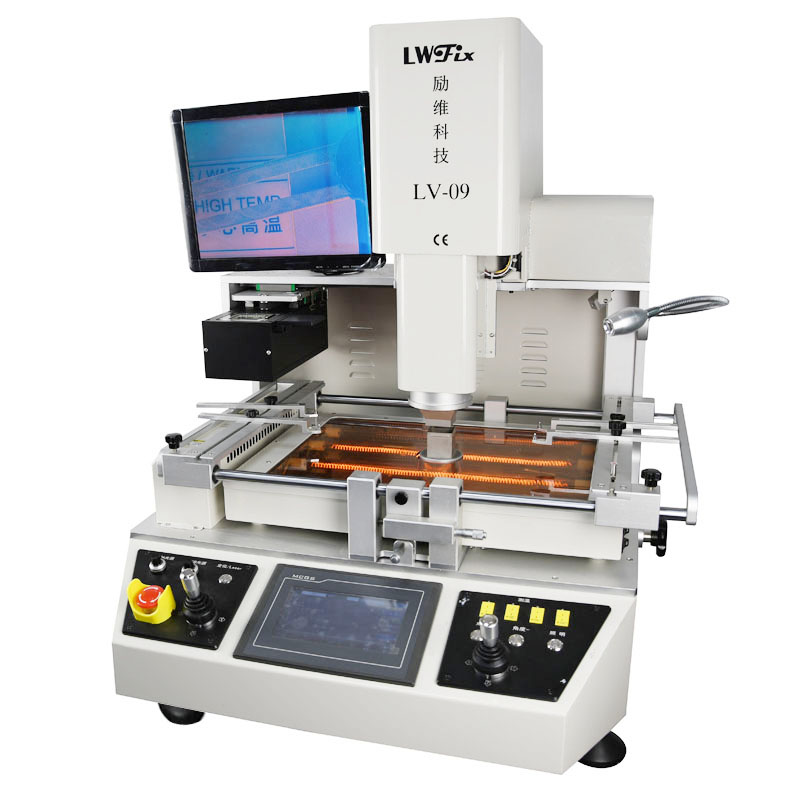
Taking the LV-09 BGA Rework Station as an example (research case equipment):
-
Total Power: 6800W, meeting the total heat input requirements for thick, multi-layer boards.
-
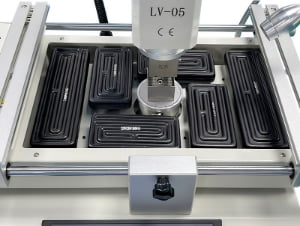
Infrared Preheating Zone: Bottom power reaches 4000W, using imported carbon fiber heating tubes and German Schott glass, covering an area of 590×460mm.
-
Multi-Point Temperature Control: Equipped with 4 independent temperature sampling channels, distributed thermal monitoring prevents regional cold spots and stress deformation.
-
- -
V. Application Case Study: AI Infrastructure Repair (Austin, USA)
An AI data center maintenance company in Austin, Texas, encountered serious pad delamination problems when repairing 16-layer AI accelerator motherboards.
-
Problem Background: Using a 4500W rework station, insufficient board bottom temperature resulted in a 35% board damage rate.
-
Technological Upgrade: Introduced the LV-09 high-power IR preheating system, preheating the entire board to a stable 160°C.
-
Result: Pad delamination rate dropped from 35% to 0%, saving over $2 million in equipment costs in the first quarter.
-
- -
VI. Conclusion: Upgrade Your Thermal Management, Secure High-Value Repair Orders
Stop battling the "heat monster" with brute force, and instead control heat transfer with a scientific infrared preheating strategy. Equipped with a high-power rework platform and a distributed thermal control system, you can not only save circuit boards worth tens of thousands of dollars but also rebuild customer trust in your technical capabilities.
FAQ: Multilayer PCB Rework & Server PCB Repair
Q1: What makes multilayer server PCBs difficult to rework? A1: The combination of high layer count, thick copper planes and large board size creates very high thermal mass, which absorbs heat quickly and makes BGA reflow difficult on standard rework systems.mermarinc+1
Q2: Do I really need a high‑power BGA rework station for multilayer PCB repair? A2: For large, thick or copper‑dense server PCBs, systems below about 5000 W total power often struggle to reach proper reflow temperatures without overheating components, increasing the risk of cold solder joints and pad lifting.solder+2
Q3: How does infrared bottom preheating improve BGA rework quality? A3: High‑wattage IR bottom preheating saturates the PCB and internal copper planes, reducing top–bottom temperature gradients and allowing the top heater to use safer, lower air temperatures while still achieving full solder reflow.vjelectronix+1
Q4: Can damaged multilayer PCBs still be repaired? A4: In many cases, yes. Pads, traces and even some internal defects can be addressed with professional multilayer PCB rework and repair services, as long as the base laminate and internal structure are not severely burned or delaminated