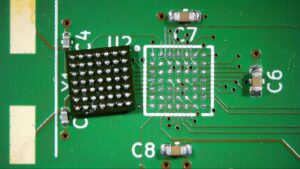
In professional electronics repair, a “bargain” BGA rework station can quickly become the most expensive mistake your shop ever makes. A common scenario discussed in repair communities is this: a technician attempts a routine GPU reflow, the machine’s display shows a seemingly safe 220 °C, yet the chip substrate is visibly charring while the solder balls remain solid—this is a classic case of temperature runaway.
What Is Temperature Runaway in BGA Rework?
Temperature runaway occurs when the heating system continues to deliver energy because the temperature sensor does not reflect the real-time thermal state of the solder joint. The result is a dangerous mismatch between the displayed temperature and the actual joint temperature, leading to charred chips, lifted pads, and warped motherboards that are difficult or impossible to rework successfully.
Key Temperatures and Why Precision Matters
The “Death Zone” in Lead-Free BGA Rework
Lead-free solder such as SAC305 (Sn96.5/Ag3.0/Cu0.5) melts at approximately 217 °C, while the glass transition temperature of many common PCB laminates begins around 140 °C. A deviation of just 15 °C beyond your target reflow profile can accelerate interlaminar delamination, substrate damage, and pad lifting, especially if time above liquidus is not controlled.
The Accuracy Gap in Low-Cost IR Stations
Low-cost, open-loop infrared (IR) BGA rework stations often exhibit a thermal lag of 20–40 °C between the sensor reading and the actual solder joint temperature. This gap is the main reason why a display that appears safe can still burn the board, and it explains why “cheap” stations frequently produce inconsistent and risky results in BGA rework.
Why “Hot” Is Not Always “Uniform”
Even when peak temperature is within an acceptable range, poor heat distribution can still destroy a board. If the top of the chip overheats while the solder balls remain below liquidus, you get “scorched earth” repairs: localized charring, lifted pads, and warped PCBs that may fail immediately or during later thermal cycling.
Root Causes: Lack of Feedback and Poor Thermal Zoning
Most entry-level BGA rework devices rely on a single sensor and essentially open-loop heating. They cannot compensate for the thermal mass of modern multilayer PCBs, heat sinks, or large ground planes, so the controller keeps pushing power long after parts of the assembly have already overheated.
Without a dedicated bottom heater and a high-speed feedback loop, the top heater must work overtime, blasting the chip surface with excessive heat to bring the bottom solder balls to liquidus. This approach creates steep thermal gradients that are directly responsible for pad lifting, warpage, and latent reliability failures.
The Solution: High-Precision Closed-Loop Thermal Control
To master BGA rework, technicians must move from guessing temperature to actively controlling thermal energy. A professional BGA rework station should monitor both the PCB surface and the component package, then adjust power in milliseconds to follow a defined thermal profile for ramp, soak, and reflow stages.
Upgrading from manual hot air or basic IR plates to PLC-controlled, closed-loop systems is strongly correlated with higher first-pass yield; many service centers report substantial improvements once they standardize on automated, profile-driven processes.
LV06 BGA Rework Technology: A Practical Implementation
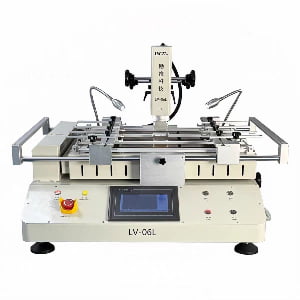
The LV06 BGA Rework Station is designed specifically to remove the variables that cause temperature runaway in BGA rework. It combines precise sensing, independent thermal zones, and PLC-stored profiles to deliver repeatable, production-grade results.
-
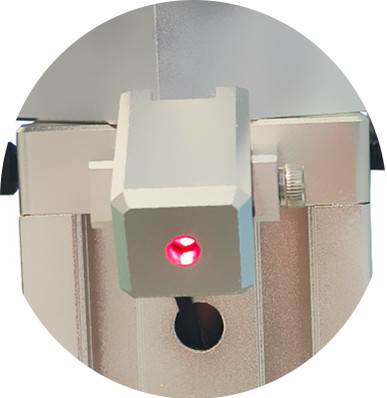
Precision Sensing for Real Joint Temperatures Equipped with a high-accuracy K-type thermocouple closed-loop control system, the LV06 monitors temperature with a precision of approximately ±3 °C. This level of accuracy helps ensure that the temperature displayed on the screen closely matches what the chip and solder joints are actually experiencing.
-
Independent Triple-Zone Heating The LV06 uses a three-zone strategy: upper and lower zones employ controlled hot air, while a third zone features a powerful 2700 W IR preheater. By uniformly preheating the entire board, the system reduces thermal gradients and ensures that the top heater does not need to overcompensate, keeping the chip surface well below the scorching point while still achieving full reflow at the solder balls.
-
PLC-Stored, Repeatable Temperature Profiles Instead of relying on manual adjustments and operator “feel,” the PLC-controlled interface allows users to store multiple “gold standard” temperature profiles for common BGA packages. Once a profile is defined, the machine executes the ramp-up, soak, and reflow stages with consistent timing and slopes, improving repeatability across different operators and jobs.
Case Study: Reducing Scorch Rate on Game Console BGA Repairs
A high-volume consumer electronics repair center in São Paulo, Brazil, was experiencing a 30 % scorch rate on PlayStation 5 and Xbox Series X HDMI chip repairs when using entry-level IR plates. The massive thermal mass and heat-sink effect of modern consoles forced technicians to boost top heat to around 260 °C, which routinely damaged surrounding plastic connectors and charred the APU area.
After upgrading to the LV06 BGA Rework Station, the facility leveraged the 2700 W IR bottom heater to safely raise the board’s ambient temperature. This improvement allowed them to reduce the top-heater peak to a safer 225 °C while still achieving reliable lead-free reflow.
Within the first month, the scorch rate dropped to under 2 %, and the shop’s reputation in the São Paulo gaming community improved significantly, driving an estimated 40 % increase in monthly repair contracts.
Conclusion
-
The root of temperature runaway lies in the equipment, rather than the technician's method: low-cost, open-loop control, single-sensor BGA rework station, there is a temperature lag of 20-40°C, resulting in "safety, actual overheating of solder joints", directly causing chip carbonization, disc warping and motherboard deformation.
-
The solution is closed-loop control + multi-temperature zone + strong bottom preheating: professional BGA repair equipment changes "guess temperature" into "control energy" through high-precision thermocouple closed-loop control, independent three-temperature zone (top hot air, bottom hot air/infrared preheating), and lead-free temperature curve that can be stored and reproduced, thus significantly reducing the risk of temperature runaway and improving the success rate of one-time repair.
-
Correct equipment investment can improve the yield and commercial return at the same time: the case shows that after replacing LVC, a repair station with 2700W IR preheating and PLC curve control, the burn rate dropped from about 30% to less than 2%, and the order quantity increased by about 40%, proving that high-precision temperature control not only protects the motherboard and chip, but also directly enlarges the profit and brand reputation 06