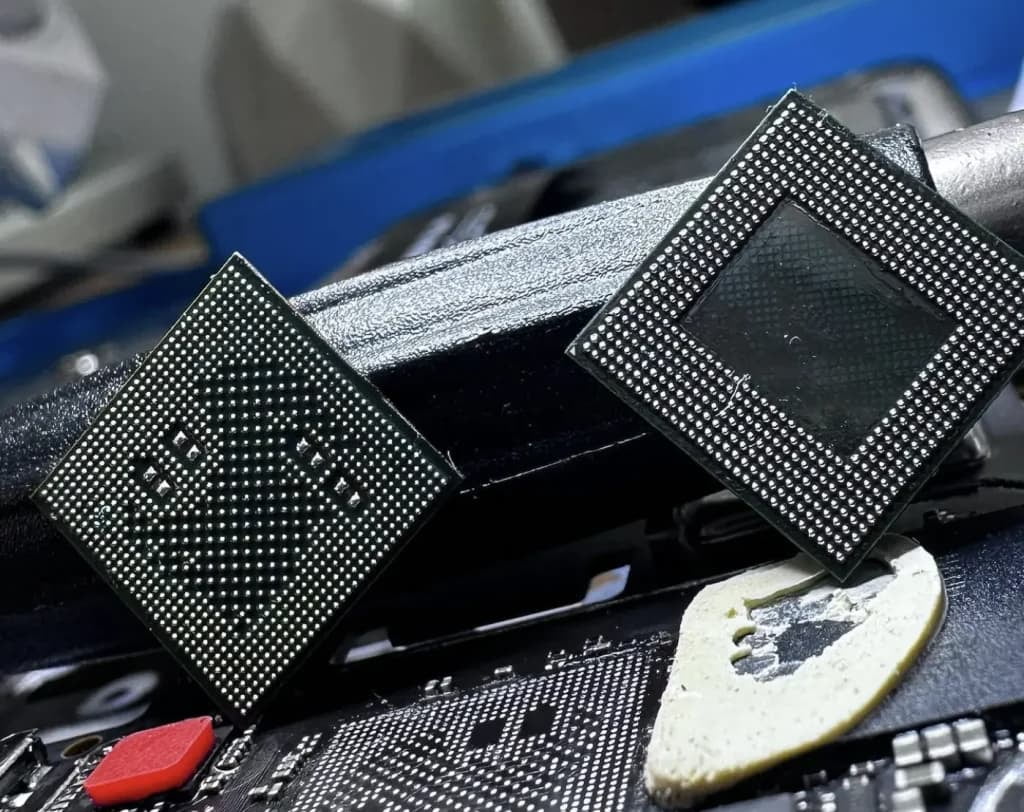
As the penetration rate of new energy vehicles (EVs) continues to rise, a notable trend has emerged in the aftermarket repair sector: the failure rate of BGA solder joints in new energy vehicle ECUs is significantly higher than in traditional fuel-powered vehicles. Such faults typically manifest as intermittent error codes, normal operation when cold but abnormal when hot, with the root cause often traced to BGA solder cracks.
During prolonged operation, thermo-mechanical fatigue causes micro-cracks to form in solder balls, leading to abnormal impedance or even intermittent open circuits.
Root Causes: Why EVs Are More Prone to “Breakdown” Than Gasoline Vehicles?
1. Intense Thermal Cycling
New energy vehicle ECUs (such as inverter controllers and BMS) directly manage high-power electrical conversion.
-
Instantaneous Temperature Rise: During energy recovery or rapid acceleration, the transient heat generated by power devices in electric motors far exceeds that of sensors in gasoline vehicles.
-
CTE Mismatch: PCB material (FR-4) and silicon chips exhibit significant differences in Coefficient of Thermal Expansion (CTE). The greater the temperature difference ΔT, the more exponentially the shear stress on solder balls increases.
📌 External Authoritative Reference: According to IPC-9701A “Thermal Cycling Test Method for BGA Solder Joint Reliability,” solder joint lifespan exhibits a nonlinear negative correlation with thermal cycling amplitude. EV's high power density significantly accelerates this degradation.
2. High-Frequency Vibration and Mechanical Stress Combination
Unlike the low-frequency vibrations of internal combustion engines, EV electronic components frequently operate in high-frequency electromagnetic vibration environments.
-
High-Voltage Busbar Stress: ECUs near high-voltage wiring harnesses endure continuous mechanical micro-vibrations.
-
PCB Warping: Under high-temperature and high-voltage conditions, multilayer PCBs are prone to microscopic physical deformation. BGA solder balls at the edges are the first to reach their fatigue limit.
📌 External Authority Reference: SAE International research indicates that the high-frequency vibration spectrum in new energy vehicles exhibits a concealed cumulative effect on fatigue damage to BGA packages.
3. OTA Updates: The Overlooked Accelerator of Thermal Aging
OTA (Over-the-Air) updates are not purely software-driven; they impose significant side effects on hardware:
-
Full-load operation: During system flashing, SoC cores typically operate at full frequency, often with cooling fans not fully activated.
-
Thermal Shock: The heat generated by high current draw in a short period is equivalent to subjecting the ECU to an “accelerated aging test.”
Comparative Analysis: Internal Combustion Engine Vehicles vs. New Energy Vehicles
| Dimension | Traditional ICE ECU | New Energy Vehicle ECU (EV) |
|---|---|---|
| Integration Level | Distributed (MCU-based) | Highly Integrated (SoC/FPGA) |
| Thermal Cycling Frequency | Follows engine start/stop, relatively smooth | Follows energy recovery/high-voltage charging/discharging, extremely frequent |
| Package Type | Primarily QFP/QFN (with pins) | Extensive use of BGA (leadless package) |
| Primary Stress | High temperatures in engine compartment | Thermal shocks from power switching |
Industry Consensus: Can Failed ECUs Be Repaired?
Replacing entire boards (assemblies) due to BGA solder joint failures incurs extremely high costs. In professional engineering environments, BGA Rework represents a viable scientific solution.
-
Technical Prerequisites: PCB must not be delaminated, and the chip itself must not be damaged.
-
Standard Procedure: Follow IPC-7711/7721 standards for precision temperature-controlled desoldering, pad cleaning, and reballing.
-
Reliability Assessment: Qualified rework processes can restore over 80% of the original design lifespan, offering far greater reliability than used parts from dismantled vehicles.
Conclusion
BGA failures in new energy vehicle ECUs are not merely simple quality defects, but rather systemic engineering challenges arising from high-performance computing and high-power environments.
For vehicle owners and engineers alike, understanding the physical essence of “solder joint fatigue” not only aids in fault diagnosis but also empowers us to make more cost-effective, rational decisions between “expensive assembly replacements” and “scientific chip-level repairs.”
If you’re evaluating whether an ECU is repairable,just choose Cost Comparison / Decision Guide / Third-Party Reliability