BGA Reballing: The Ultimate Professional Guide to Successful Chip Repair
In the electronics repair industry, fixing BGA (Ball Grid Array) packages is considered the crown jewel. Whether repairing graphics cards with screen flickering, gaming consoles with blue lights, or laptop motherboards that won't boot, BGA Reballing is the critical process that breathes new life into discarded devices.
This article will take you deep into the standard procedures for professional-grade reballing and how to enhance repair success rates through scientific temperature control.
What is BGA Reballing? Why is it so crucial?
BGA Reballing refers to the process of completely removing old solder balls from beneath a chip and implanting new ones.
Why is reballing necessary?
-
Intermittent Connections: Solder joint fractures caused by prolonged thermal expansion and contraction.
-
Alloy Embrittlement: Lead-free solder is prone to tin whisker formation or brittleness under high temperatures.
-
Chip Upgrades/Recycling: Reusing core chips salvaged from discarded boards.
Important Note: According to IPC-7711/7721 standards, successful BGA rework hinges not on “blowing heat,” but on “uniform heat distribution” and “precise temperature profiles.”
Core Equipment List: More Than Just a Heat Gun
To achieve a success rate exceeding 95%, an entry-level heat gun is often insufficient.
| Tool Name | Professional Recommendation | Function |
|---|---|---|
| BGA Rework Station | Recommended with optical alignment and bottom heating system | Prevents motherboard warping, ensures alignment accuracy |
| Flux | Select Amtech or equivalent No-clean flux | Reduce residue, enhance wettability |
| Stencils | Prioritize Direct Heat or machine-specific stencils | Avoid solder bridging due to stencil warping during heating |
| Solder Balls | 63/37 leaded balls (easier handling) or SAC305 lead-free balls | Restore circuit connections |
Five Key Steps for Professional Chip Reflow
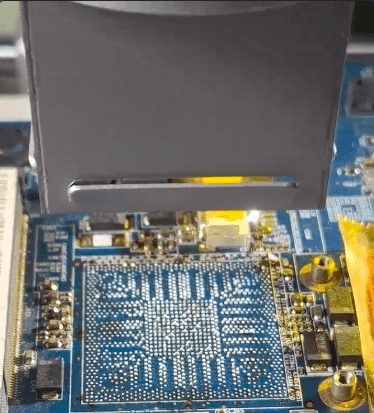
Step 1: Chip Removal and Pad Cleaning
Heat the chip to reflow temperature using a rework station, then remove it. Gently clean the pads using solder wick and a knife-tip soldering iron.
- Caution: Never drag the soldering iron forcefully to prevent pad damage.
Step 2: Apply Flux and Align the Stencil
Apply a thin layer of flux to the chip surface. Excessive flux causes solder balls to “run” during heating. Precisely align the stencil over the chip pads.
Step 3: Inserting Solder Balls
Pour solder balls into the stencil and gently shake to distribute them into the holes. Recycle excess solder balls.
Step 4: Reflow Soldering
This is the most critical step. Use a dedicated oven or the heating function of a rework station.
- Core Reference: Consult the Reflow Profile. The preheat phase must reach 150°C. Peak temperature should be maintained at 210-220°C for leaded solder and 235-245°C for lead-free solder.
Step 5: Cleaning and Inspection
Use isopropyl alcohol (IPA) to remove excess flux. Inspect solder ball coplanarity under a microscope.
Scientific Temperature Control: The Secret to Preventing Chip Damage
Many beginners encounter situations where “a repaired chip works for two days before failing again,” typically due to thermal stress damage.
Professional BGA rework stations utilize independent top and bottom temperature control to ensure uniform heating across the entire PCB. Using only a hot air gun for localized heating causes the motherboard to physically warp due to extreme temperature differentials. Even if soldered successfully, internal stresses will quickly pull apart the joints.
1. Preheat Zone — The Foundation for Stress Relief
-
Technical Requirements: The ramp-up rate must be strictly controlled between 1–3°C/sec.
-
Expert Perspective: Excessively rapid preheating causes thermal shock to the PCB, leading to PCB warping. Insufficient preheating prevents complete volatilization of flux in solder paste, resulting in voids. Our equipment employs high-sensitivity temperature sensors to provide real-time feedback and adjust heating power, ensuring a smooth, seamless temperature ramp.
2. Soak Zone (Constant Temperature/Activation Phase) — Key to Eliminating Temperature Variations
-
Technical Requirements: Maintain temperatures between 150°C and 180°C (for lead-free processes) for 60–120 seconds.
-
Expert Perspective: The objective here is to minimize ΔT (Delta T)—the temperature differential between large and small components. Simultaneously, the flux activates during this phase, removing oxidation layers from pad surfaces. A precise bottom preheating system is central to reducing ΔT, representing the fundamental difference between professional rework stations and inexpensive hot air guns.
3. Reflow Zone — The Moment of Metallurgical Bonding
-
Technical Requirements: Peak temperature (Peak Temp) should exceed the alloy's liquidus point by approximately 20–30°C. For common SAC305 lead-free solder, the liquidus point is 217°C, thus the peak should be controlled between 235–245°C.
-
Expert Perspective: TAL (Time Above Liquidus)—the duration above the melting point—should be controlled between 45–90 seconds. Insufficient time causes “cold solder joints”; excessive time leads to thick intermetallic compound (IMC) layers, resulting in brittle joints. Our equipment employs multi-point PID temperature control algorithms, maintaining peak temperature fluctuations within ±1°C.
4. Cooling Zone — Crystalline Structure Stabilization
-
Technical Requirements: Recommended cooling rate is 2−4°C/sec.
-
Expert Perspective: Rapid, controlled cooling produces fine-grained structures that significantly enhance joint mechanical strength and fatigue resistance. However, excessive cooling speed can introduce residual thermal stresses, making equipment supporting “controlled active cooling” the preferred choice for high-end laboratories.
Summary
BGA reballing is not merely a technical skill—it is a science of temperature. By utilizing a professional BGA rework station, adhering to IPC soldering standards, and setting precise temperature profiles, you can standardize what was once a complex repair process, significantly boosting customer satisfaction and profitability.
Frequently Asked Questions (FAQ)
Q1: Should I use leaded or lead-free solder balls for ball placement?
A: For rework, beginners are advised to use 63/37 leaded solder balls. Their low melting point (183°C) provides a wider operating window and minimizes thermal damage to components. However, for factory-compliant production, lead-free solder balls must be used.
Q2: Why does my stencil warp when heated?
A: This is typically caused by uneven heating. We recommend using high-quality 304 stainless steel stencils, preheating them before use, or employing specialized soldering fixtures for stabilization.
Q3: Can BGAs be reworked without an optical alignment system?
A: Yes, but manual alignment success rates drop significantly for chips with pitches under 0.5mm. For costly equipment repairs, optical alignment systems save substantial rework time.