The Cost of Guesswork in Modern Micro-Rework
In high-density electronics repair, guessing equals gambling. For components with 0.3mm or finer pitch, even microscopic misalignment can lead to solder bridging or open joints. Technicians depending on unaided eyesight or low-grade optics face increasing failure rates—turning what should be a routine reflow into a destructive experiment.
Modern rework demands machine-assisted precision, not manual “luck.” This is where split-vision alignment and micrometer positioning define the new industry benchmark.
The Data: Quantifying the Precision Gap
Industry benchmarks underscore how alignment accuracy directly determines rework success.
The Margin of Error
For a standard 0.5mm pitch BGA, a 0.05mm offset (roughly one human hair) raises short-circuit risk by over 60% during reflow collapse.
The “Re-Rework” Cost
Nearly 40% of rework failures are caused by poor alignment or uneven ball placement—translating to an average 2.5 hours of labor loss per defective board.
The First-Pass Yield (FPY) Advantage
Facilities using split-vision optical alignment systems report up to 99.9% first-pass yield, compared to 65% for manual “blind” operators.
The Problem: The “Blind Box” Effect
Without real-time optical feedback or X-ray inspection, technicians complete reflow cycles without knowing what happened beneath the surface. Whether the chip rotated 1 degree or bridged two pads, the result is unpredictable failure—and repeated heating cycles. Each additional reflow weakens PCB integrity, causing delamination, trace warping, and dielectric breakdown.
This hidden uncertainty is what professionals call the “Blind Box Effect.”
Root Causes: Human Visual Limitation and Mechanical Instability
Two main factors drive precision loss during BGA mounting:
-
Human Limitation: Human eyes cannot simultaneously align hundreds of 0.2mm solder balls over their corresponding pads.
-
Mechanical Tolerance Issues: Low-end rework machines introduce axis "play"—when the heater head lowers, the component subtly shifts, ruining calibration.
Consequently, what looks aligned before reflow often ends up catastrophically off-center after solder collapse.
The Engineering Solution: Split-Vision Optics and Micrometer Control
Eliminating guesswork requires replacing human estimation with optical verification and mechanical precision.
Split-Vision Optical Alignment
This technology merges two real-time images—the chip’s solder balls and the PCB’s pads—into one overlay view. The technician can visually confirm perfect alignment before placement, ensuring consistent centering across every joint.
Micrometer-Level Axis Control
A ±0.01mm mechanical resolution enables adjustments across X, Y, and R (rotation) axes. This precision guarantees correct component positioning, even for micro-BGAs and fine-pitch QFNs.
The Benifit Way: LV-07 BGA Rework Station
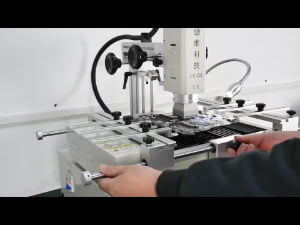
The LV-07 BGA Rework Station sets the benchmark for precision electronics rework through optical integration and micron-level control.
-
High-Definition Split-Vision System Using an advanced prism assembly, the LV-07 overlays two color-coded images with 1x–200x magnification, letting technicians confirm exact solder ball alignment before placement.
-
Micrometer-Tuned Positioning All three axes—X, Y, and R—are adjusted via fine-pitch micrometers, delivering repeatable ±0.01mm accuracy. This precision prevents “micro drift” common in cheaper mechanical systems.
-
Intelligent Mounting and Welding Modes The system features four operational modes—Remove, Mounting, Weld, and Semi-Auto—combining optical accuracy with controlled automation. Once alignment is verified, the motor-driven head ensures consistent, vibration-free placement.
Case Study: Aerospace Electronics Precision in Bangalore, India
In the defense electronics sector, reliability is non-negotiable. A major aerospace maintenance firm in Bangalore, India faced repeated rework failures on FPGA flight-control boards—each containing over 1,000 I/O pins.
-
The Challenge Using manual alignment systems, technicians achieved only 50% first-pass yield. Each rework required recertification, delaying projects and inflating costs.
-
The Implementation After adopting the LV-07 with its split-vision color overlay system and micrometer-tuned precision, technicians validated every corner of each FPGA before heating.
-
The Results
-
First-pass yield: 50% → 100% within one week
-
Annual savings: ≈ $120,000 in hardware scrap reduction
-
Outcome: Secured multi-year satellite component repair contracts for verified precision
Conclusion: Precision determines success or failure
The competition in BGA rework has evolved from "being able to repair" to "being able to repair precisely". Eliminating "blind-box" operations and achieving visualized and verifiable precise solder ball alignment are the keys to improving yield and reducing costs.
The LV-07 BGA Rework Station, with its split-light dual-view overlay system and micron adjustment mechanism, has successfully solved the problems of vision and mechanical stability, making ±0.01mm precision a reality.
Whether it is smart terminal maintenance or high-reliability aerospace electronics, precise control is no longer an option but a technical foundation for enterprises to maintain competitiveness. Mastering precision is equivalent to mastering the future of profits and reputation.